 OneClickGrowth
The Evolution of Content Strategy: Why Automated Planning is Essential for Modern Visibility
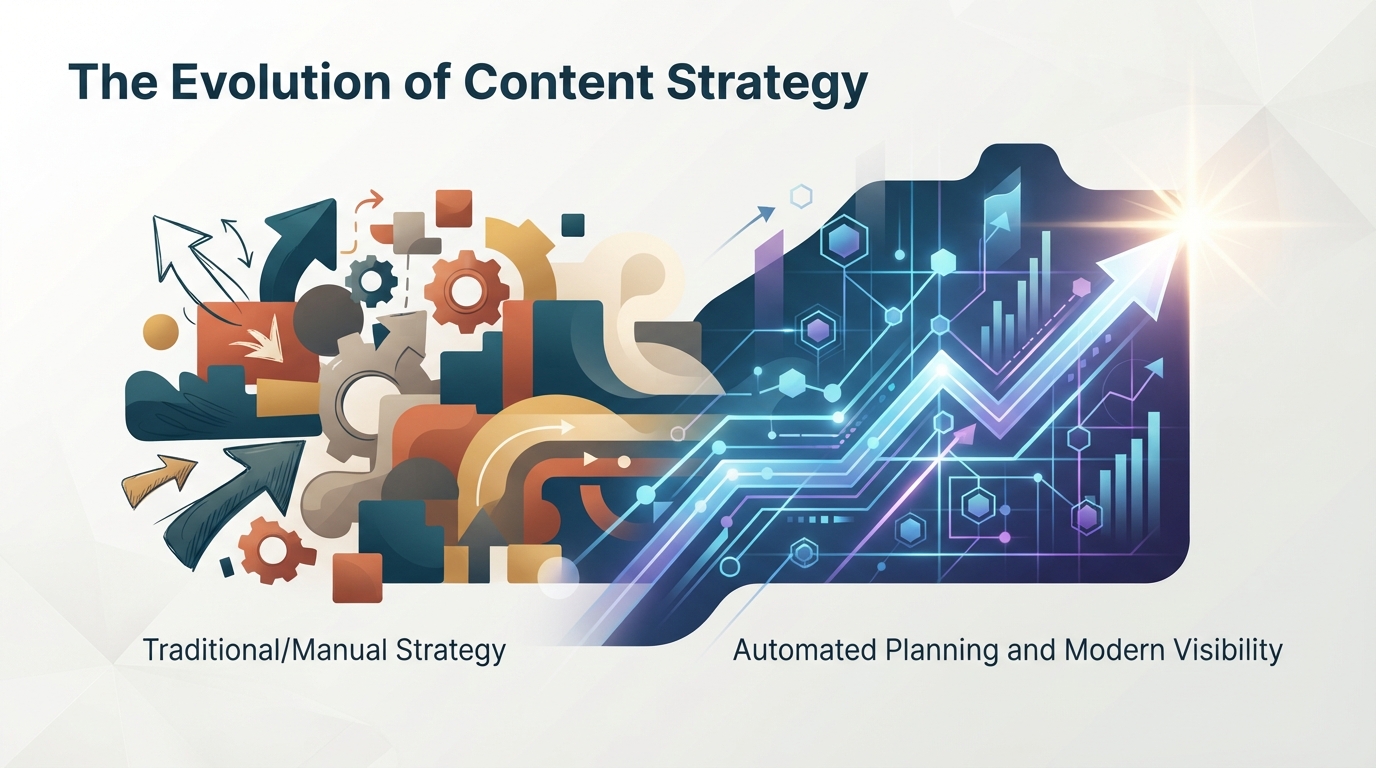
A standard marketing department spends up to fourteen hours every week manually auditing competitor websites, compiling spreadsheet keyword lists, and attempting to map content ideas to shifting search behaviour. In an era where generative search engines are redefining how users retrieve information, this manual approach is no longer sustainable. Marketing leaders are finding that by the time a static content plan is approved and written, search trends have moved on, and new AI-driven platforms have updated their retrieval algorithms.
To maintain a competitive edge, brands must transition to an integrated, automated approach. Modern content planning is no longer merely about organising a calendar; it is about algorithmically identifying topical gaps, understanding how generative engines synthesise information, and deploying structured content that commands authority. This article explores how automated content planning software transforms online visibility and why an algorithmic approach to content strategy is essential for modern businesses and agencies.
The Shift from Manual Calendars to Algorithmic Content Planning
For years, content calendars were constructed using historical search volume data and subjective team brainstorming sessions. This process frequently resulted in static editorial plans that quickly fell out of alignment with real-world user intent. Today, the velocity of online search requires a more dynamic approach, rendering traditional manual planning obsolete. Algorithmic content planning utilises real-time data ingestion and predictive analysis to map out exactly what topics a brand must cover to capture relevant audience attention.
By automating this process, organisations can shift from a reactive posture to a proactive strategy. Instead of guessing which topics might resonate based on outdated search queries, automated software identifies emerging trends and patterns. This ensures that every piece of content produced serves a distinct strategic purpose, directly aligning with what users are actively searching for across both traditional and AI-driven platforms.
Furthermore, manual planning fails to account for the complex web of topical authority. Search engines no longer view articles in isolation; they assess the depth of an entire domain on a specific subject. Algorithmic planning software maps these relationships automatically, outlining clusters of related content that build comprehensive authority. This structured approach ensures that content production resources are allocated efficiently, eliminating duplicate efforts and targeting high-value opportunities.
Why Traditional Keyword Research Misses the Generative AI Wave
Generative Engine Optimisation (GEO) represents a fundamental departure from old-school SEO practices. Traditional search focused heavily on exact-match keywords, meta-tag optimisation, and backlink volume. In contrast, modern search systems powered by large language models synthesise information from multiple sources to provide direct, comprehensive answers. If your content strategy is built solely around legacy keyword metrics, your brand risks becoming invisible on these newer interfaces.
Automated content planning software addresses this shift by evaluating how generative engines perceive and cite information. It analyses the semantic structure of your content, ensuring that it answers complex, conversational queries rather than just simple search phrases. This level of optimisation requires a deep understanding of natural language processing and entity relationships, tasks that are impossible to perform manually at scale.
By integrating GEO principles into your content strategy planning, you ensure your brand is positioned as a primary source for generative responses. The software identifies the specific structures, definitions, and citations that AI engines favour when formulating answers. This ensures your content is not only crawlable by traditional search engines but also highly referenceable by generative algorithms, maximising your visibility across all digital touchpoints.
The Mechanics of Automated Content Auditing and Gap Analysis
An effective digital strategy cannot be built without a clear, objective understanding of your existing content library. Manual audits are notoriously prone to human error, often overlooking deeper technical structures or subtle topical gaps. Automated website analysis bypasses these limitations by scanning entire domains in minutes to evaluate content depth, technical health, and overall relevance.
During an automated audit, the system maps your current pages against a comprehensive model of your industry's topical landscape. This reveals critical content gaps—areas where your competitors are establishing authority but your site remains silent. By identifying these discrepancies automatically, marketing teams can instantly see where their strategy is falling short and which topics require immediate attention.
This systematic approach also helps identify underperforming content that requires optimisation. Rather than deleting old articles or writing entirely new ones from scratch, the software highlights pages that can be refreshed with minimal effort to yield significant performance gains. This data-driven prioritisation ensures that your content team is always working on tasks that deliver the highest return on investment.
Streamlining Ideation and Workflow Automation for Marketing Teams
Once content gaps are identified, the bottleneck invariably shifts to content ideation and production pipelines. Creative blocks, misaligned briefs, and disjointed workflow management can delay campaigns by weeks. Automated content planning software bridges this gap by turning analytical data into actionable writing briefs instantly, streamlining the journey from concept to creation.
With content ideation and workflow automation, the software generates detailed outlines that include recommended headings, target intent profiles, semantic terms, and structural suggestions. This level of automation removes the guesswork for writers, ensuring that every draft is strategically aligned with the brand's broader visibility goals from the very beginning. It transforms a chaotic creative process into a structured, repeatable production line.
Additionally, these automated workflows facilitate better collaboration among team members. By centralising the ideation and briefing process within a single platform, editors, writers, and strategists can work in perfect alignment. Review cycles are shortened, approval bottlenecks are minimised, and the overall volume of high-quality content production can scale without a corresponding increase in management overhead.
Scalability for Agencies: Managing Diverse Portfolios with Unified Dashboards
For marketing agencies, managing the content pipelines of multiple clients presents a significant operational challenge. Siloed tools, disparate spreadsheets, and inconsistent reporting mechanisms frequently lead to administrative bloat and communication breakdowns. A unified agency dashboard solves this complexity by consolidating multi-tenant operations into a single view.
An effective dashboard allows agency partners to monitor the health, strategy, and performance of various clients simultaneously. It provides a standardised framework for reporting, making it easy to demonstrate value to stakeholders without spending hours compiling manual decks. Agencies can showcase precise insights, such as identified content gaps filled, GEO improvements, and overall growth in search visibility.
Moreover, scaling agency operations requires the ability to onboard new clients and establish their strategy rapidly. Automated planning software allows agencies to run immediate website analyses and generate comprehensive growth plans for new accounts within days rather than weeks. This speed and precision not only impress new clients but also allow agency teams to execute campaigns faster, driving quicker results and improving client retention rates.
Measuring Impact: Moving Beyond Vanity Metrics to True Search Visibility
The ultimate success of a content strategy is no longer measured solely by keyword rankings on a static search page. As generative search engines synthesise answers, brand visibility must be evaluated by a new set of parameters, including citation frequency, brand mentions, and conversion intent. Automated platforms provide the granular tracking needed to measure these sophisticated metrics.
By focusing on comprehensive search visibility, brands can understand how their content influences users at different stages of the buyer journey. Traditional metrics often fail to capture the nuance of informational queries that build brand trust long before a transaction occurs. Automated systems track how effectively your content addresses top-of-funnel (TOFU), middle-of-funnel (MOFU), and bottom-of-funnel (BOFU) search intents, providing a holistic view of your marketing funnel.
Furthermore, integrating these metrics into your ongoing strategy planning creates a continuous feedback loop. When the software detects a shift in how search engines retrieve your content, it automatically suggests adjustments to your existing strategy. This agile approach ensures that your brand remains visible, authoritative, and resilient to search algorithm updates, securing long-term organic performance.
Transforming Content Planning into an Engine for Growth
Navigating the complexities of modern search visibility requires a platform that unifies audit, strategy, and execution. OneClickGrowth provides a comprehensive suite of AI-driven tools designed to simplify your marketing workflow. From initial website analysis to sophisticated Generative Engine Optimisation, our platform delivers the exact steps required to elevate your brand’s presence.
By utilising our Content Strategy Planning module, you can eliminate the manual overhead associated with keyword research and content mapping. The platform automates the identification of high-value topical opportunities and generates detailed, structured briefs that empower your creative team. Whether you are an in-house marketing team or a scaling agency, OneClickGrowth provides the infrastructure to build, scale, and measure a high-performing content programme.
The future of digital marketing belongs to brands that adapt to the algorithmic shift. By replacing fragmented, manual processes with OneClickGrowth's unified, AI-powered workflow, you gain the clarity and speed required to capture search visibility across both traditional and generative platforms. Book a demo today to discover how our automated content planning software can accelerate your organic growth.
Conclusion
Transitioning from manual content planning to an automated, algorithmic system is no longer a luxury for forward-thinking brands—it is a necessity for survival in a generative search landscape. By leveraging automated website audits, GEO strategies, and unified workflow dashboards, businesses can build sustainable topical authority that drives consistent organic growth. OneClickGrowth offers the exact tools required to streamline this transition, allowing your team to focus on what matters most: creating exceptional, authoritative content that connects with your audience.
Frequently Asked Questions
What is automated content planning software?
Automated content planning software uses artificial intelligence and real-time data to audit websites, identify content gaps, and generate structured strategic outlines. This eliminates manual keyword research and spreadsheet management, aligning your content with both traditional search engines and generative AI platforms.
How does automated planning support Generative Engine Optimisation (GEO)?
GEO requires content to be structured so that large language models can easily synthesise and cite it. Automated planning tools analyse content semantics, entity relationships, and conversational search patterns to ensure your articles are optimised for retrieval by generative AI search systems.
Can marketing agencies use this software to manage multiple clients?
Yes. OneClickGrowth features Agency Partner Management Dashboards, allowing agencies to oversee multiple client portfolios, track website health, identify unique content gaps, and generate white-label performance reports from a single, unified interface.